
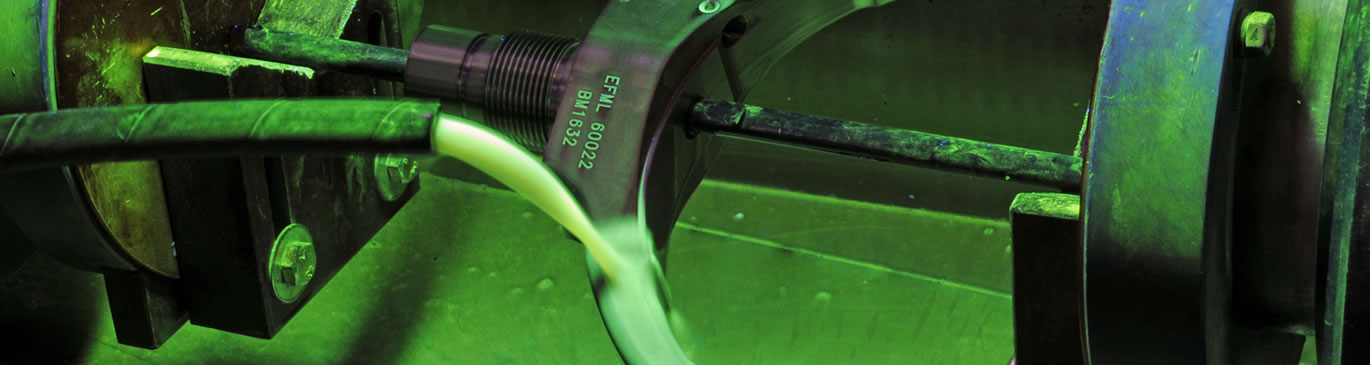
Magnetic Particle testing is a versatile inspection method used for field and shop applications. Magnetic particle testing works by magnetizing a ferromagnetic specimen using a magnet or special magnetizing equipment. If the specimen has a discontinuity, the magnetic field flowing through the specimen is interrupted, and a leakage field occurs. Finely milled iron particles coated with a dye pigment are applied to the specimen. These are attracted to leakage fields and clusters to form an indication directly over the discontinuity.
Magnetic Particle Inspection Advantages :
- Can detect both surface and near subsurface indications.
- Can inspect parts with irregular shapes easily.
- Pre-cleaning is not as critical as for some other inspection methods.
- Fast method of inspection and indications are visible directly on the specimen surface.
- Considered low cost compared to other NDT techniques.
- Very portable inspection, especially when used with battery-powered equipment
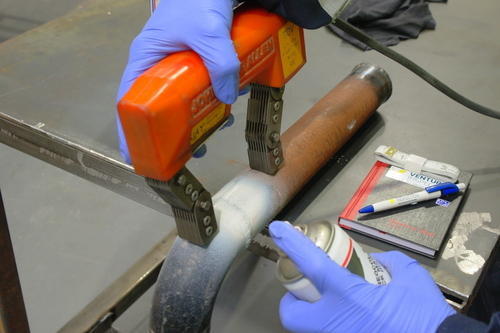
Magnetic Particle Testing (MT) at SNDT
Magnetic Particle Testing (MT) detects surface and slightly sub-surface discontinuities in ferromagnetic materials. SNDT applies wet, dry and fluorescent techniques using yoke, prod and coil magnetisation to ASME Section V, ASTM E1444/E709 and client specifications.
MT is used on welds, castings, forgings and structural steel to find cracks, laps and porosity that visual inspection can miss. Every job includes correct magnetisation, indication interpretation by certified Level II technicians and full demagnetisation afterwards, with documented reports for code compliance.
Related NDT Services: Ultrasonic Testing · Dye Penetrant Testing · Advanced NDT
Frequently Asked Questions
What is Magnetic Particle Testing (MT)?
MT reveals surface and near-surface cracks in ferromagnetic materials by applying a magnetic field and iron particles that gather at flaw leakage fields – a fast, sensitive surface method for welds, castings and forgings.
When is MT used instead of Dye Penetrant (PT)?
MT is used on magnetic (ferrous) materials and can find slightly sub-surface flaws; PT is used on non-magnetic materials and only finds surface-breaking defects. SNDT selects the right method for the material.
Which standards does SNDT follow for MT?
MT is performed to ASME Section V, ASTM E1444/E709 and client specifications, by certified Level II technicians with full demagnetisation and documented reports.