
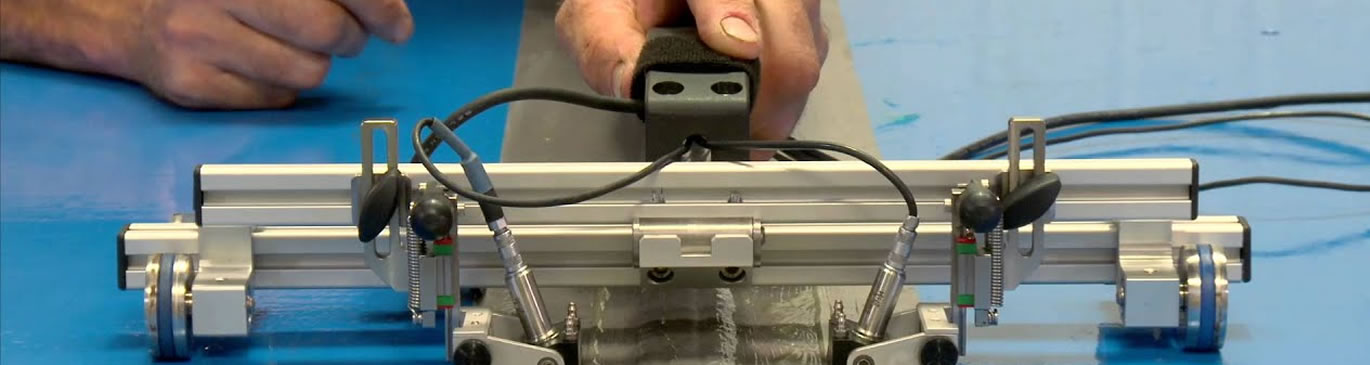
TOFD Utilizes diffracted energy in the detection of flaws; the technique is less reliant on flaw orientation and morphology than standard pulse echo techniques, leading to improved sizing and probability of defect detection (PPOD). Additionally, computerized electronic data capture and storage, in conjunction with scanning manipulators enable rapid scanning speeds to be achieved TOFD has now been accepted as an alternative to Radiography in Pre-Service Inspections with standards such as ASME 2235, and its use in pipe weld and thick walled pressure vessel fabrication is now common place.
TOFD Advantages :
- TOFD defect detection does not depend on the defect orientation, in contrast to the pulse echo technique.
- Defect height can be exactly determined, thus most suitable for monitoring growth or changes in known defects.
- Most efficient for inspection of thick-walled vessels where X & Gamma ray would re-quire too much time.
- TOFD method can be used to observe and report microscopic degradation caused by fatigue, stress and chemical attack – it has proven possible to quantify micro cracking caused by copper dilation through weld electrode contamination providing some knowledge of the probable fault mechanism is suspected prior to intervention.
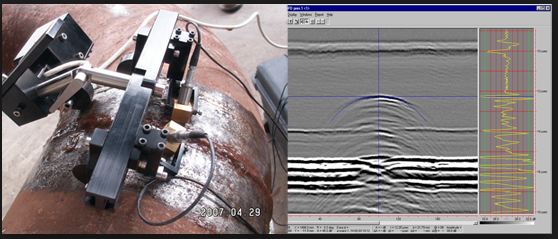
How TOFD works and why it is chosen
Time of Flight Diffraction (TOFD) measures the ultrasonic waves diffracted from the tips of a flaw to size and monitor weld defects with high accuracy and repeatability, to ASME Section V and ASTM E2373. It is fast, leaves a permanent digital record and, unlike radiography, uses no ionising radiation.
SNDT commonly combines TOFD with PAUT to replace radiography on pressure-vessel, pipeline and storage-tank welds – covering both new construction and in-service monitoring, with encoded data that can be re-reviewed and audited.
Related NDT Services
Phased Array UT (PAUT) · Ultrasonic Testing · Radiographic Testing
Frequently Asked Questions
What is Time of Flight Diffraction (TOFD)?
TOFD is an advanced ultrasonic technique that uses diffracted sound waves from the tips of a flaw to accurately size and monitor weld defects, offering a fast, highly repeatable alternative to radiography.
TOFD vs Radiography - which is better for welds?
TOFD is safer (no radiation), faster and provides accurate through-wall flaw sizing, and is often combined with PAUT to replace radiography for pipeline and pressure-vessel welds.
Where is TOFD applied?
TOFD is used for new-construction weld inspection and in-service monitoring of pressure vessels, pipelines and storage tanks.